From data to action: PANTOUR’s Skills Framework transforms Tourism & Hospitality in Europe

From data to action: PANTOUR’s Skills Framework transforms Tourism & Hospitality in Europe

03/16/2026 - 12:58

After four years of EU-funded research and cross-sector collaboration, the PANTOUR project has reached its conclusion. As lead partner, BUas played an important role in setting up and rolling out the Skills Intelligence Monitoring System, led by BUas researcher Corné Dijkmans, and the European and National Research Communication and Dissemination Strategy for the project, led by BUas researcher Lobke Elbers. The results are concrete, actionable, and directly relevant to tourism educators and researchers.
Tourism
  • Kennis
  • Nieuws
  • Onderzoek

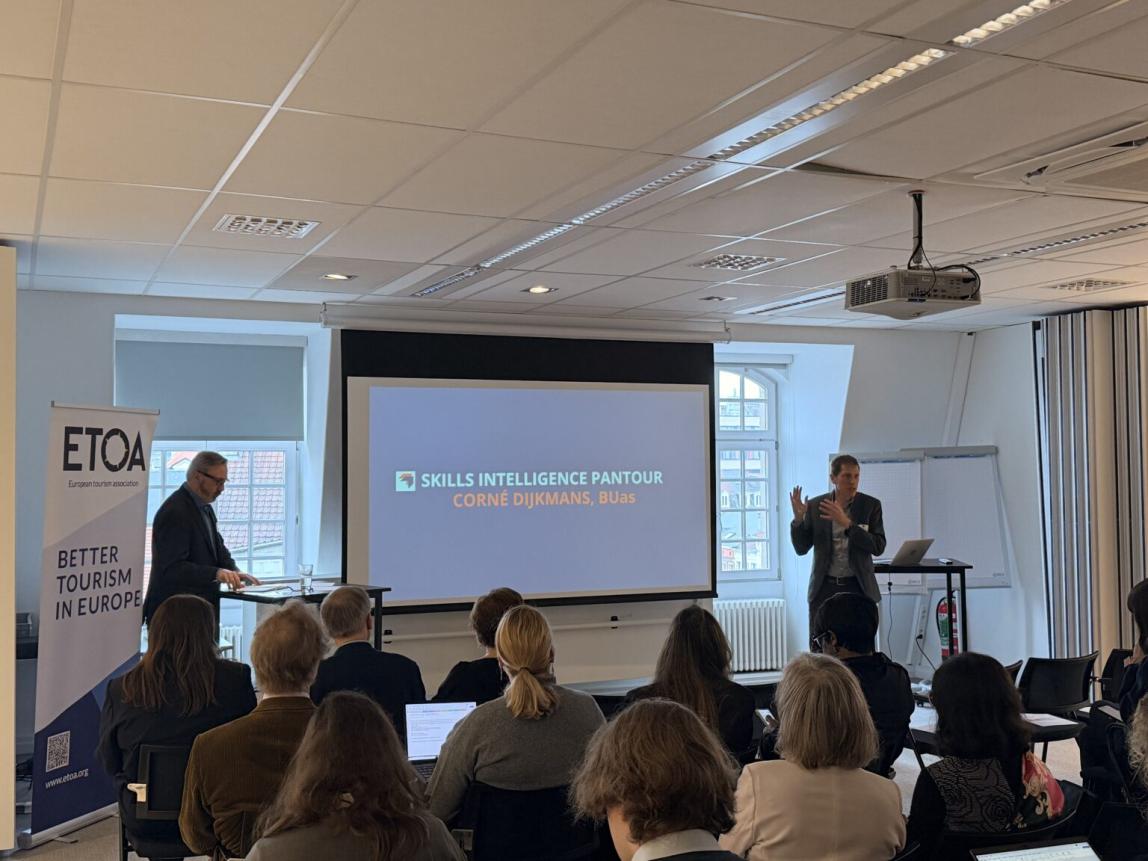
The final conference, held in Brussels on 24 February 2026, brought together industry leaders, policymakers, Vocational Education and Training (VET) providers and Higher Education Institutions (HEI) to present the project's key outputs and the path forward for Europe's tourism workforce in the light of skills development and the digital and green transition. 

A skills intelligence monitor built on research 

At the heart of PANTOUR is the Sectoral Skills Intelligence Monitor, developed with a rigorous mixed-methods approach combining secondary data analysis, stakeholder surveys, best practice interviews and focus groups. BUas researcher Corné Dijkmans led the design and development process of this methodology for the European tourism and hospitality sector, together with BUas researcher Lobke Elbers, who led the delivery of the research results and stakeholder communication across ten European countries, including the Netherlands.  
The monitor produces European and country-level Sectoral Skills Profile Reports from 2024-2026, offering evidence-based insight into current and future competence needs across tourism subsectors – from hospitality and tour operations to visitor attractions and travel agencies. 

For educators, this matters as the monitor directly informs curriculum development, helping HEI and VET partners update programmes to reflect real labour market demand, including growing needs around data literacy, sustainability and digital skills.  It also helps enterprises of all sizes, from large companies to SMEs, to make better strategic choices about, for example, job profiles, talent development, personnel policy (such as attracting and retaining employees) and lifelong learning. 

Training programmes grounded in gap analyses 

Rather than building on generic curricula, PANTOUR's updated training programmes,  going live in May 2026, were developed from EU-wide skills gap analysis. They span digital competences (including AI and robotics), green skills (carbon management, environmental responsibility) and social competences (crisis resilience, inclusive workplace culture). All programmes are aligned with the European Qualifications Framework (EQF), ensuring coherence and transferability across national contexts. 
The training programmes are supplemented with a ‘PANTOUR guidance book’. This is a practical handbook for trainers delivering tourism skills programmes, intended for use within VET institutions, higher education and public or private training organisations, but equally applicable in industry settings such as hotels and restaurants. It offers pedagogical guidance, methods and tools to improve training quality, align content with EU qualifications frameworks, and adapt materials to different formats (face-to-face, online or hybrid). The overall aim is to support effective learning outcomes and high-quality training delivery. 

The Tourism Skills Lab: from static reports to dynamic tools 

The Tourism Skills Lab is a digital platform translating research into practice. Built around a skills matrix covering 35 digital, green and transversal skills mapped to EQF levels, the platform enables employees, small and medium-sized enterprises (SMEs) and training providers to identify skills gaps, match profiles to job roles and access relevant training. For researchers, it represents a shift towards living, data-driven tools that grow in value as participation grows. 
On the Next Tourism Generation - Pantour website you can find specific benefits for different target groups. 

A skills strategy with 45 actionable priorities 

PANTOUR's Skills Strategy and Action Plan, planned for publication in June 2026, includes stakeholder consultations across 12 countries and covers seven strategic priorities supported by 45 concrete actions. These priorities address workforce attractiveness, digital transformation, green innovation, lifelong learning and inclusion. 

The broader message is clear: the PANTOUR consortium has moved Europe's tourism skills agenda from diagnosis to delivery. The frameworks, tools and partnerships are in place. The focus is now shifting to implementation, uptake and embedding of these resources into national and institutional strategies.   
The FuTourAlliance project, which kicked off in January 2026 with BUas once again acting as the lead partner in the field of Skills & Training Intelligence, builds on the work of PANTOUR. and addresses the skills gap and the urgent need to prepare the workforce for the digital and sustainable transformation: Shaping the future of skills in European tourism | Buas Content Hubs | BUas Tourism 
 
The final slide deck of the PANTOUR Conference in Brussels, including all presentations and detailed information, can be downloaded here