Digital toolkit bridges skills gap for European Cultural Routes
11/25/2025 - 11:31

- Research
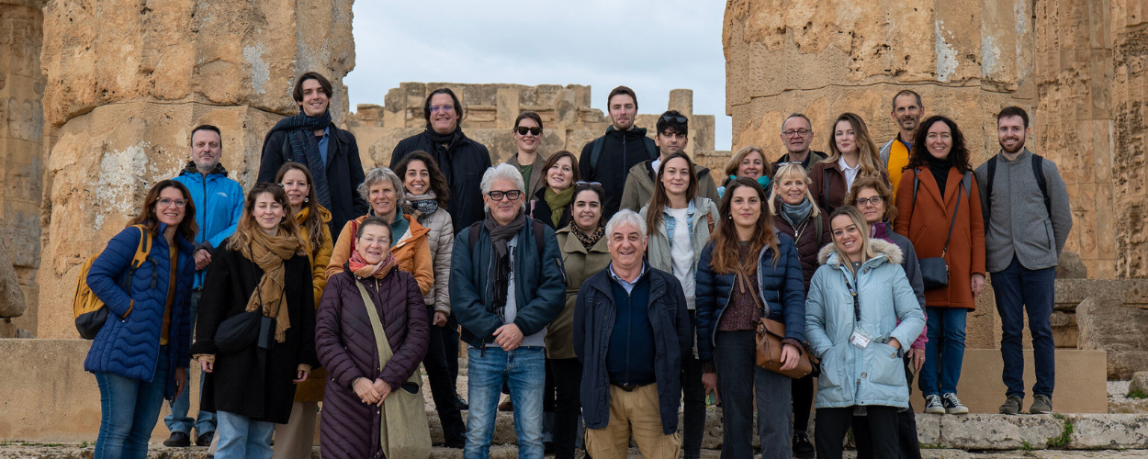
NEXT ROUTES, a project within the professorship of Digital Transformation in Cultural Tourism (DTCT), recently concluded with a closing conference in Forlì, Italy. The project is a European collaboration of Cultural Routes certified by the Council of Europe, the tech company Mobile Idea Srl, and Breda University of Applied Sciences to create a comprehensive digital toolkit and training framework for Cultural Routes professionals.
Preserving Europe's Cultural Heritage
The project addressed a fundamental challenge: making Cultural Routes more visible and accessible to ensure the preservation of European heritage. ’Cultural Routes link local heritage to the wider movements of ideas and encourage collaborative grassroots initiatives which give European citizens a sense of ownership and pride,’ explains Frederike van Ouwerkerk, one of the project members.
’Our role in the consortium was to serve as an advisory partner, supporting the Cultural Routes in developing strategies to better bring out the value and promote their cultural heritage, create shared visibility, and attract wider and younger audiences,’ project member Licia Calvi says.
Cultural Routes include different categories of cultural heritage besides monuments and sites, such as landscapes, rural areas, intangible heritage, and archeology. According to Frederike, Cultural Routes have unique potential for ’shared experiences and intercultural dialogue, attract mixed social groups and cultures and emphasise a ”simple”, more or less ”exploitation-free” form of tourism.’
Addressing complex challenges
According to Licia Calvi, the main obstacles facing Cultural Routes is that ’Cultural Routes typically operate with limited staff, relying heavily on volunteers. Consequently, professionals working with these routes may lack familiarity with the latest digital tools and strategies, such as AI applications, that could help promote and enhance the visibility of their routes,’ Calvi explains.
The complexity extends beyond staffing issues. The transnational nature of Cultural Routes presents unique challenges, requiring the routes to bridge diverse realities across multiple countries while managing intercultural communication.
The team conducted a comprehensive assessment of needs. ’The extensive knowledge of these complex cultural networks, and the insights the partners shared, helped shape the project's scope and the desired training deliverables. It was really interesting to listen and learn first-hand,’ project member Lobke Elbers adds.
Gamification as engagement strategy
A central innovation was the application of gamification to cultural heritage. Mobile Idea developed a location-based game designed to make Cultural Routes more appealing to younger generations.
’Gamification in the context of cultural heritage means developing products for enjoyment, fun, inspiration and knowledge in a playful way. This might be digital but not necessarily,’ Frederike explains.
Tech Company Mobile Idea developed a basic concept for a location-based game that was then populated with content provided by each route. The game foresees the exploration of a predefined environment by means of missions that guide the player forward in their exploration of the environment and of the hidden gems and stories associated to it while gaining points. The game format was specifically chosen to appeal to younger audiences.
Training Framework and lasting impact
The project delivered four training modules forming a transnational Training Framework. ’As digital technologies continue to reshape how heritage is documented, presented and shared, the Training Framework supports professionals to upskill on creating and managing digital content, using digital platforms and tools to increase public engagement,’ Lobke says.
’The modules help the Cultural Routes to strengthen their storytelling capabilities and expand their knowledge of practical and adaptive gamification solutions to develop fresh, engaging, and future-proof cultural experiences. Overall, the modules are designed to move smoothly from understanding to doing: theory, practice, reflection, and real-world application’.
Looking forward
The project's resources will remain accessible beyond its conclusion. ’The products that we developed will be made publicly available on the website of each of the partners. A follow-up project where these products will be deployed and customised per partner is also in the making,’ Licia reveals.
Start your adventure today
Start your adventure today. Hundreds of missions are waiting to be completed. Collect digital stamps in your personal passport along the European Cultural Routes. Whether you are a local rediscovering your region or a traveller seeking authentic experiences, the NEXT ROUTES gamification-app transforms how you explore cultural heritage. Download the app, including 6 Cultural Routes across Europe, and start your adventure today at https://nextroutes.enemyx.net (available only on mobile).
Download
Interested? Download the Transnational training framework for Cultural Routes staff here.