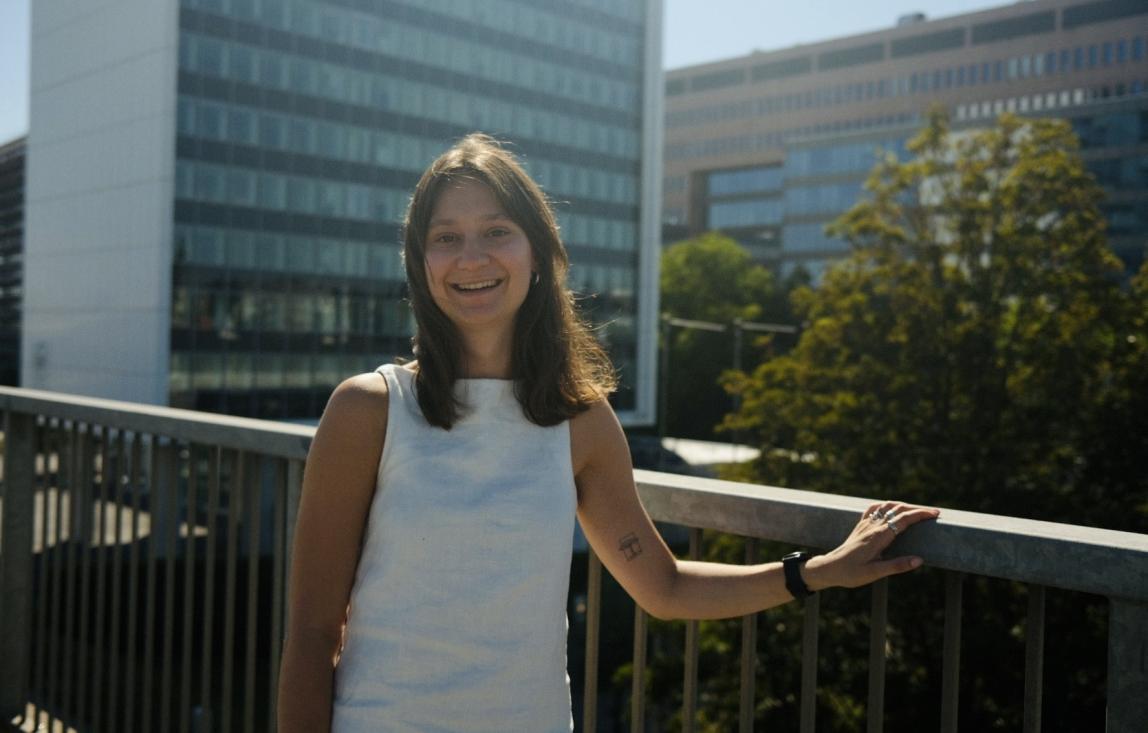
New PD candidate Justine Bauters puts residents at the heart of tourism governance

New PD candidate Justine Bauters puts residents at the heart of tourism governance

04/02/2026 - 10:45

Whether a place needs tourism and what shape it takes is a question that belongs to the people who live there. That's the conviction driving Justine Bauters, who has recently started a professional doctorate at Breda University of Applied Sciences (BUas), researching how citizens can meaningfully participate in shaping regenerative tourism governance.
Tourism
  • Kennis
  • Onderzoek
  • TDM

From Flanders to Breda, and back again

Justine's path to this research is anything but abstract. After completing her bachelor's in tourism and recreation management in Brussels, followed by an internship in a fast growing travel agency, she pursued a master's in Tourism Destination Management at BUas to better understand how governments can manage the impacts of tourism. This experience also marked her first introduction to regenerative tourism as a concept. Her thesis examined how the theoretical framework of regenerative tourism has been applied to Travel to Tomorrow, Visit Flanders' strategic vision.

’During my master's, I realised that regenerative tourism isn't just a new buzzword, it fundamentally shifts the question from ”how do we grow tourism?” to ”what does this place actually need?” says Justine. ’And to answer that question, you have to involve the people who live there.’

After graduating, she joined NECSTouR, a European network of sustainable tourism regions, supporting Destination Management Organisations (DMOs) in sustainable tourism. There she focused her work on climate action. She now works as an analyst at IDEA Consult in Belgium, where she guides co-creative processes and qualitative research in tourism policy – and it is here that her professional doctorate will be embedded.

The research: making participation more than a tick-box exercise

Regenerative tourism places social cohesion, liveability, mobility and environmental quality at the heart of destination development, not just visitor numbers or economic output. But here's the catch: genuinely involving citizens in tourism governance is notoriously difficult. Participation processes too often fall into tokenism, or keep engaging the same voices while those most affected by tourism remain unheard.

Justine's research addresses this gap head-on. Her central focus is on developing, testing and evaluating participatory approaches that help DMOs, civil society organisations and citizens collaboratively shape regenerative tourism governance, grounded in a Flemish context, but designed to be transferable across comparable European destinations.

’I've seen how easy it is for participation to become a formality,’ she says. ’My research is about finding approaches that actually work, where residents aren't just consulted, but genuinely co-create the future of their home.’

A method built on collaboration

To do this, Justine applies Participatory Action Research (PAR), a cyclical, collaborative methodology in which stakeholders don't just inform the research – they actively contribute to it. It's an approach that mirrors the very values she is researching: shared ownership, iterative learning and real-world application.

Her supervisory team brings together exactly the expertise the subject demands. Dr Jeroen Klijs (BUas) supervises from a tourism and societal impact perspective, while Dr Trui Steen of KU Leuven and Dr Léon Acar of Ghent University contribute deep knowledge of public governance and citizen co-production. Their combined perspectives offer a valuable complementarity across tourism and governance research. IDEA Consult provides the professional environment that connects the research to real-world practice, while Vincent Nijs of Visit Flanders serves as a key industry sparring partner.

Community at the heart of tourism's future

The value of this research extends well beyond academia. As destinations across Europe grapple with the consequences of overtourism, climate pressure and shifting resident attitudes, the question of how to involve communities in tourism decision-making is urgent, and largely unanswered.

’If we want tourism to genuinely regenerate places, we need governance structures that reflect what communities actually value and aspire to,’ Justine explains. ’My research is about building the tools to make that possible.’

With one foot in research and the other in practice, Justine is well placed to bridge the two, and to make sure that the people who call a destination home get a real seat at the table.